Farmers weigh up carbon benefits

This content was created in partnership with Google Trends.
The Australian government introduced legislation to the Parliament on August 20th to further strengthen the nation’s world-leading carbon crediting scheme to ensure it continues to drive down pollution and deliver economic opportunities across regional and rural communities.
The Bill amends the Carbon Credits (Carbon Farming Initiative) Act 2011 by enhancing transparency and integrity in the Australian Carbon Credit Unit (ACCU) Scheme, while simplifying and streamlining how the scheme operates and improving the recognition of First Nations rights and interests, learning from over 10 years of implementation.
Assistant Minister for Climate Change and Energy, Josh Wilson, said the legislation would ensure confidence in the capacity of the ACCU and associated schemes to deliver effective reductions in Australia’s emissions and provide certainty to investors, industry and communities involved in the schemes.
“Multiple independent reviews have found the scheme to be sound in delivering substantial emissions abatement,” Mr Wilson said.
“The changes further strengthen the scheme, ensuring it remains fit for purpose and keeps pace with a dynamic and growing carbon market.”
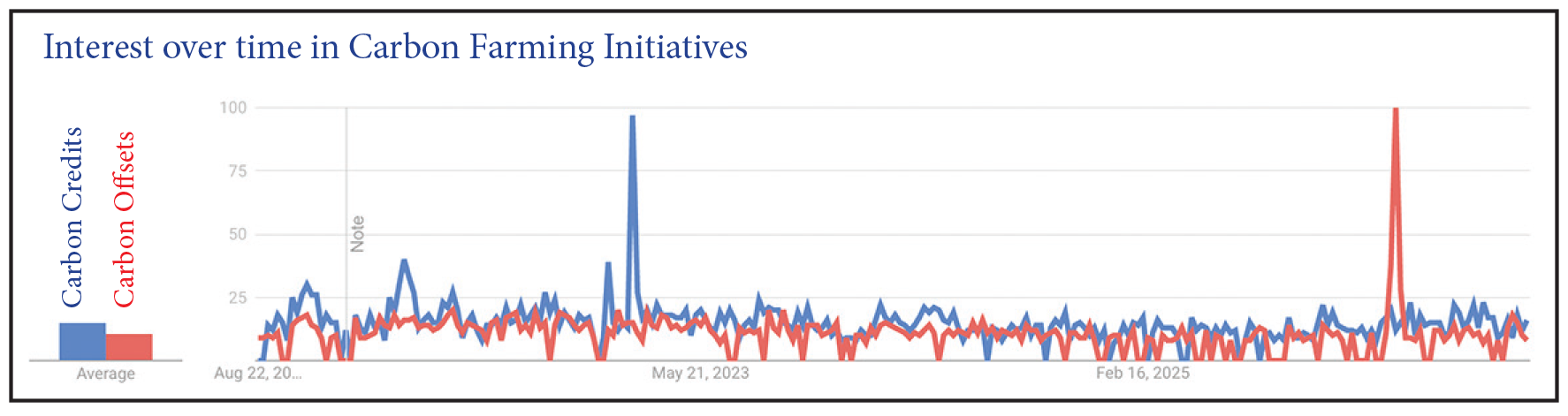
Australian search interest in both carbon credits and carbon offsets has increased significantly over the past year.
Google Trends data (see graph below) shows Australian search interest in carbon credits has risen sharply with average interest over the past 12 months around 30 per cent higher than during the previous year.
Interest in carbon offsets has climbed even faster increasing by around 48 per cent year-on-year and reaching a five-year peak in February 2026.
Factors behind the spike included heavy emitters facing a major March 31, 2026 compliance deadline under the reformed Safeguard Mechanism to ensure they do not exceed their emissions baselines which led to heightened procurement and trading activity.
Many corporations ramped up engagement with the ACCU scheme during January and February to lock in units before the quarter ended.
The Australian Clean Energy Regulator (CER) also released its quarterly Carbon Market Report in February which revealed that while 2026 ACCU supply would reach a robust 22 to 26 million units, rapidly declining emissions baselines meant that annual demand is projected to outpace supply later this decade.
However, the increased acquisition of productive regional land by corporate buyers and carbon project developers has sparked widespread community debate and has drawn criticism from industry bodies.
The Victorian Farmers Federation (VFF) has taken a critical and highly cautious stance on the expansion of carbon credit schemes, actively raising alarms about large corporations and carbon funds purchasing prime Victorian agricultural land to lock it up for carbon sequestration.
While the VFF supports the overarching goal of net zero emissions by 2050 and recognises the value of on-farm carbon reduction, the peak agricultural body strongly opposes allowing the ACCU scheme to compromise Australia’s food security.
Buying regional farmland for ‘revegetation’ is around 60 per cent cheaper for big polluters - - particularly coal, oil and gas - than cutting their own emissions, according to a recent Herald Sun investigation.
The proposed new rules to replace the ‘least cost’ carbon credit purchasing model with ‘value for money’ allow the government to reward projects that deliver broader benefits to farmers and communities.
Farmers for Climate Action (FCA) has provisionally welcomed the rule changes but says research shows big industrial polluters increased their carbon credit usage by nearly 50 per cent in a single year to meet targets, while their actual emissions barely dropped or even rose.
The FCA is calling for stricter safeguard nechanisms so big polluters are forced to reduce emissions at the source, rather than relying on farmland carbon credits to offset unmitigated pollution.
In recent years an entire Alpine cattle station and as many as 30 dairy farms have been purchased in Victoria to plant forests instead of food.
The major sale of the 32,000 hectare Cobungra Station near Omeo for $50.3M last month to carbon asset manager Silva Capital (backed by Rio Tinto and BHP) has caused concern.
The new owners plan to generate ACCUs by integrating wide-scale native tree planting alongside traditional cattle farming.
Similarly, German-owned Otway Silva has bought as many as 30 Victorian dairy farms and converted them into blue gum forests.
To help maintain food security, the National Farmers Federation (NFF) is calling for Australia to cap farm-to-forest conversions at 25 per cent of any property, matching New Zealand’s limit.
Locally, the Mountain View carbon project at Tintaldra, owned by the Costello family, spans a 129-hectare area of a larger 422-hectare cattle grazing operation.
Rather than a total corporate buyout, it is an example of an active operational farm utilising multi-species pastures and managed grazing duration to capture soil carbon, having successfully secured its first issuance of ACCUs to access premium carbon-neutral beef markets.
“We started the project around five years ago to improve our land capability and production,” Justin Costello said.
“It increases our water holding capacity which provides greater depth for grass roots and a longer growing season which in turn, boosts our production.
“Overall, it will ensure long term sustainability of the land.”
Under the Victorian government’s $77 million BushBank program, delivery partners like Cassinia Environmental work with private landowners across regions like the Upper Murray to tap into carbon offset markets.
This includes specific targeted public land restoration blocks inside the Burrowa-Pine Mountain National Park (Fluospar and Greenhills plots) and Mt Mittamatite North.
The ACCU scheme is currently delivering more than 190 million tonnes of abatement from 2631 projects, valued at more than $4B.
This content is part of a paid partnership with Google to promote Google Trends