Mergers offer a lifeline but no guarantee

This content was created in partnership with Google Trends.
After a second consecutive winless football season at senior level, the Corryong Football Netball Club recently held a Members’ Meeting to plot the club’s future for 2027 and beyond.
The Demons compete in the four-club Upper Murray Football Netball League (UMFNL) and were facing the prospect of forfeiting their first match in 2026 because of a shortage of player numbers but a rallying call via social media resulted in the club competing in all games at senior and reserve level.
However, the senior team has now notched 30 consecutive losses including finals since its last win in round nine in 2024. The Demons last senior premiership was in 2017 with a 62-point victory over Bullioh.
It is likely that Corryong will struggle for numbers again for the 2027 season and if it joins the Federal and Border-Walwa clubs in recess at some time in the future, the league will be left with just three clubs - Cudgewa, Bullioh and Tumbarumba.
The club’s fate has generated increased online search interest and comment over the past year.
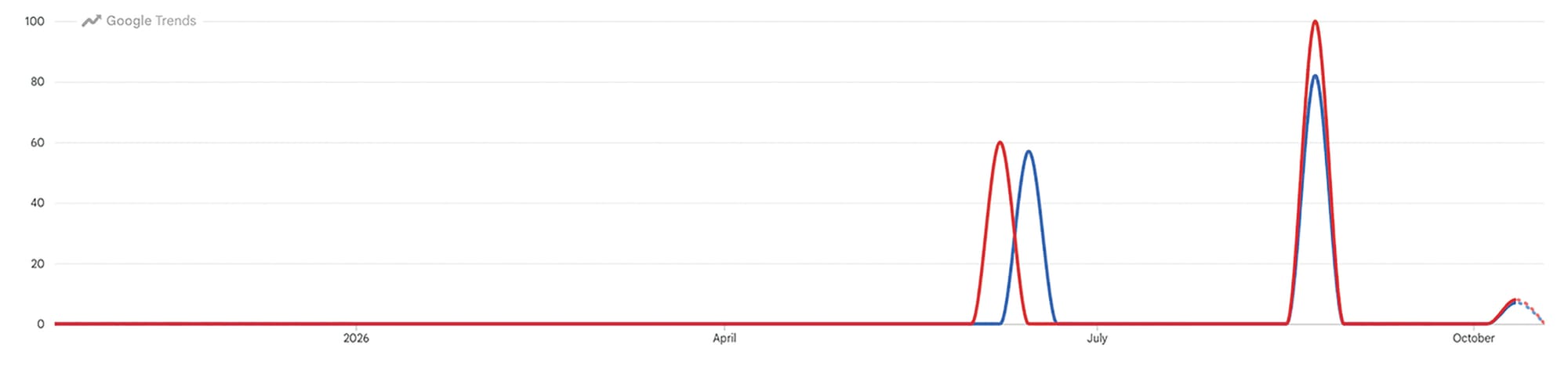
Google Trends data (see graph below) shows Australian search interest in Upper Murray football and netball has had significant spikes in that time - in March, September and October.
In March, the Corryong club faced the bleak prospect of forfeiting its first game a week out from the season start and finals action was a key search in September, while the Demons held the members’ meeting about its future direction in October.
Corryong will hold its annual general meeting this Wednesday, October 21st.
Few decisions in country football stir more emotion than asking traditional rivals to become teammates. A club’s colours carry generations of loyalty, family history and community pride. Changing them can feel like surrender.
This type of deep-seated parochialism has been a major factor in Upper Murray clubs rejecting any merger proposals with Corryong and neighbours Federals failing to get a union across the line on two occasions.
Unfortunately, the time for Upper Murray clubs to put old rivalries aside and make decisions based on survival and sustainability and the future of local football and netball may have passed.
It was identified as far back as the late 1990s when an options paper was presented to the league highlighting a significant decline in student enrolments at Corryong College (almost 50 per cent in 25 years) which would have a flow-on effect on player numbers.
At that time, the Federal and Corryong clubs agreed in principle to merge and join the Tallangatta & District Football League - a move that would have provided stronger long-term sustainability and better junior development pathways.
However, Corryong later withdrew from that plan.
Over the past 40 years, mergers have become a recurring feature of football in country Victoria. The record offers both encouragement and caution - amalgamation can preserve local sport and produce enduring success but it cannot guarantee either.
The extent of change is substantial. In April 2024, The Weekly Times reported that more than 50 country clubs had folded or agreed to mergers since 2000. That combined figure should not be mistaken for 50 mergers but it illustrates the scale of the pressure on country football.
Some unions have built impressive records.
Minyip-Murtoa won three senior premierships in its first four seasons following a merger. Irrewarra-Beeac’s senior footballers claimed three consecutive flags in 2008, 2009 and 2010, more than two decades after amalgamation.
Its league also records a strong junior base and substantial netball success. These are examples of merged clubs developing identities and achievements of their own
Ouyen United’s union with Walpeup-Underbool delivered another compelling result. Entering the Sunraysia league in 2016, the combined team defeated Mildura to win the senior premiership in its first season. Former opponents had found a way to share a future.
More recently, Calder United, formed by Nullawil and Wycheproof-Narraport, won both senior and reserves premierships in its inaugural North Central season in 2025. That is a remarkable beginning, although lasting viability takes longer to establish
However, the cautionary examples deserve equal attention.
Devon-Welshpool-Won Wron-Woodside, formed in 1997, won senior flags in 1998, 1999 and 2003. Judged only by its trophy cabinet, the merger appeared highly successful successful but a section of the club subsequently broke away to establish Woodside and District, which began playing in 2008. The club’s own history identifies travel, thinning volunteer numbers and the burden of maintaining two grounds among the pressures preceding the split.
That experience exposes the weakness of measuring a merger by September results alone. Premierships can lift spirits and attract support but they do not necessarily resolve questions of geography, facilities, workload or belonging
The fundamental question is what is the likely outcome without amalgamation?
A merger that sustains football and netball for another decade may represent a considerable achievement, even if further restructuring eventually becomes necessary.
There are nevertheless real costs. Fewer independent clubs can mean fewer home matches in individual towns, longer journeys and the loss of familiar community gathering places.
Success should therefore be judged across the whole club - junior participation, player retention, manageable finances, a sustainable volunteer workload and meaningful involvement from every contributing community
History suggests that mergers deserve serious consideration before a club reaches crisis point. That requires honest examination of player numbers, school enrolments, finances and importantly, the capacity of the next generation to take over.
It also requires a fair agreement. Representation, home grounds, training arrangements, assets and recognition of both clubs’ histories should be settled openly. These matters shape whether supporters feel they have helped create a new club or simply watched their old one disappear.
After 40 years, the verdict is mixed but clear enough - mergers have sustained country football in many communities and produced outstanding sporting success. They have also fractured, required further consolidation and left difficult questions about local identity.
For country Victoria, the challenge is to preserve both the game and the community around it.
The best merger is one that gives the next generation a club to belong to and the previous generation a reason to keep coming through the gate.
(This content is part of a paid partnership with Google to promote Google Trends).
Photo: Wendy Lavis.